Latest posts

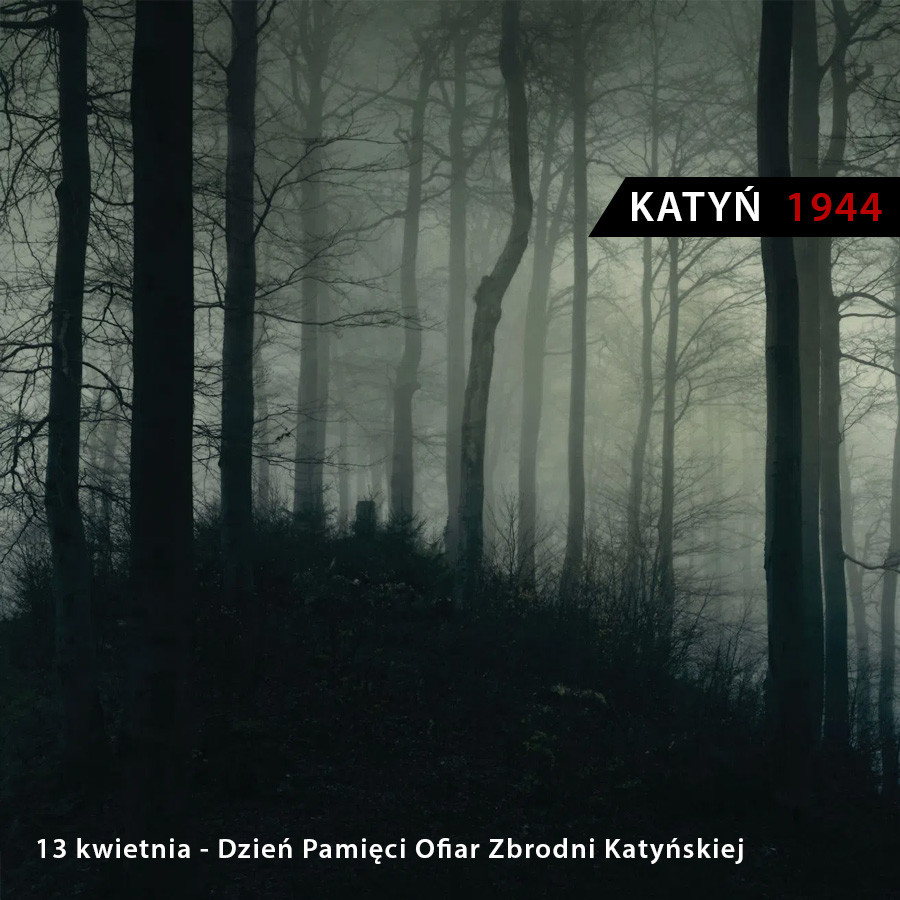
Day of Remembrance for the Victims of the Katyn Massacre

Introduction: Memory as a Measure of Sovereignty

Every year on April 13, Poland observes the Day of Remembrance for the Victims of the Katyn Massacre. It is not a ritual gesture or a symbolic date emptied of meaning. It is a solemn act of historical responsibility. The commemoration honors more than 21,000 Polish citizens—officers of the Polish Army, police officials, civil servants, professors, physicians, lawyers, engineers, and clergy—who were murdered in the spring of 1940 by the Soviet secret police, the NKVD.

The Katyn Massacre was not an accident of war, nor an uncontrolled outburst of violence. It was a calculated, centrally approved act of political extermination. On March 5, 1940, the Soviet Politburo, led by Joseph Stalin, signed a decision authorizing the execution of Polish prisoners of war and detainees held in camps and prisons across Soviet-occupied territories.[1] The decision was administrative in tone, clinical in language, and devastating in consequence.

The Day of Remembrance affirms something fundamental: historical truth is not negotiable. The massacre itself was a crime. The decades-long denial that followed constituted a second, moral crime. Remembering Katyn is therefore not merely about mourning the dead; it is about defending the integrity of history against distortion and political manipulation.


The Road to Katyn: War, Occupation, and Captivity

The origins of the massacre lie in the geopolitical collapse of Poland in September 1939. On September 1, Nazi Germany invaded Poland from the west. On September 17, the Soviet Union invaded from the east, acting in accordance with the secret protocol of the Molotov–Ribbentrop Pact. Poland was partitioned between two totalitarian regimes.

Thousands of Polish officers and officials were captured by Soviet forces. Unlike many Western armies, Poland’s officer corps was largely composed of reservists—educated professionals who, in civilian life, were the backbone of the country’s institutions. Doctors, academics, engineers, lawyers, and teachers wore uniforms in time of war. To imprison them was to imprison the intellectual and administrative core of the Polish state.

The prisoners were held in three principal camps: Kozelsk, Starobelsk, and Ostashkov. Others were detained in NKVD prisons in western Ukraine and Belarus. Interrogations followed. The NKVD sought to identify individuals deemed “counterrevolutionary,” “nationalist,” or “hostile to Soviet power.” In reality, their defining feature was loyalty to an independent Polish state.

On March 5, 1940, Lavrentiy Beria, head of the NKVD, submitted a memorandum to Stalin recommending the execution of over 25,000 Polish prisoners. The Politburo approved the proposal the same day.[1] The prisoners were condemned without trial, without defense, without notification to their families.

The executions began in April 1940. In the Katyn Forest near Smolensk, prisoners from Kozelsk were shot in the back of the head. Those from Starobelsk were killed in Kharkiv; those from Ostashkov in Kalinin (Tver). The bodies were buried in mass graves. The killings were methodical, bureaucratically organized, and carried out with chilling efficiency.


A Crime Against the Elite

The massacre was not random. It targeted the Polish leadership class. Of the approximately 22,000 victims, over 8,000 were officers; thousands more were police officers, border guards, and state officials. Many were highly educated. Among them were university professors, physicians, writers, engineers, and priests.[2]

The strategic logic was clear: remove the leadership, and the nation becomes easier to dominate. The Soviet leadership understood that a resilient society depends on individuals capable of organizing resistance, sustaining institutions, and articulating national aspirations. Katyn was therefore not simply an act of wartime brutality; it was an attempt to cripple a nation’s future.

Historians have noted that the massacre formed part of a broader Soviet policy of repression in occupied territories between 1939 and 1941, which included deportations of hundreds of thousands of Polish citizens to Siberia and Central Asia.[2] The objective was not merely territorial control but social transformation through coercion.


Discovery and Propaganda: The Birth of the “Katyn Lie”

In April 1943, German forces occupying the Smolensk region announced the discovery of mass graves in the Katyn Forest. An international commission of forensic experts concluded that the executions had occurred in the spring of 1940—when the area was under Soviet control.

The Soviet Union immediately denied responsibility and accused Nazi Germany of the crime. Diplomatic relations between the Polish government-in-exile in London and Moscow deteriorated rapidly. When the Polish government requested an investigation by the International Committee of the Red Cross, the Soviet Union broke relations, accusing the Poles of collaboration with Nazi propaganda.

At the Nuremberg Trials after the war, Soviet prosecutors attempted to attribute the massacre to Germany, but the evidence was inconclusive. Despite this, in communist Poland and throughout the Soviet bloc, the official version remained unchanged: Katyn was a Nazi crime.

For decades, the truth was suppressed. Families of the victims were monitored and intimidated. Public discussion was censored. School textbooks repeated the false narrative. The “Katyn lie” became one of the longest-sustained falsifications of modern history.


1990 and the Admission of Guilt

The breakthrough came in April 1990, when Soviet authorities officially acknowledged that the NKVD had carried out the executions.[3] Subsequent releases of archival documents confirmed the authenticity of Beria’s memorandum and the Politburo’s decision.

The admission was a milestone, but it did not resolve all issues. Questions of legal qualification—whether the massacre constituted genocide—remained debated. Russia classified parts of the investigation files and, in 2004, discontinued its criminal inquiry, declining to recognize the massacre as genocide under Russian law.

For Poland, however, the archival confirmation ended decades of enforced silence. It restored the victims’ dignity and affirmed the efforts of historians, families, and dissidents who had preserved the truth under censorship.


Legal and Moral Dimensions

Under contemporary international law, the Katyn Massacre is recognized as a war crime and a crime against humanity. The execution of prisoners of war without trial violates the Hague Conventions and fundamental principles of humanitarian law.

Yet Katyn also transcends legal classification. It represents the collision between totalitarian power and human dignity. The victims were stripped of due process, identity, and burial rites. The state that killed them sought to erase even the memory of their existence.

The moral dimension is inseparable from the legal one. A state that denies its crimes compounds them. The decades of denial inflicted secondary trauma on families and distorted public understanding of history.


Memory and National Identity

The establishment of the Day of Remembrance in 2007 formalized a practice long cultivated by families and civic organizations. It signaled that the Polish state recognizes remembrance as a civic duty.

Commemorations across Poland—ceremonies at military cemeteries, academic conferences, educational programs—are not acts of hostility toward contemporary nations. They are affirmations of historical truth.

Memory, in this context, is not an instrument of vengeance. It is a foundation of sovereignty. Nations that fail to defend historical truth risk allowing their past to be rewritten by external narratives or political expediency.


Katyn in International Perspective

Katyn stands alongside other 20th-century atrocities as a reminder of the destructive potential of totalitarian systems. Its uniqueness lies partly in the longevity of the denial. Few crimes were officially falsified for so long at such a high diplomatic level.

The massacre also illustrates the vulnerability of smaller states caught between great powers. Poland’s experience in 1939–1940 was shaped by geopolitical realities beyond its control. Yet the persistence of memory demonstrates that historical truth can outlast political domination.


The Contemporary Relevance of Katyn

More than eight decades after the massacre, Katyn continues to shape Polish historical consciousness. It influences debates about security, alliances, and relations with neighboring states. It serves as a reminder that independence requires vigilance.

At the same time, responsible remembrance demands restraint and accuracy. The tragedy must not be instrumentalized for short-term political purposes. Its power lies in its documented reality and moral clarity.

Educational initiatives play a crucial role. Younger generations, distant from the events of World War II, must understand both the facts and the broader implications: how propaganda distorts truth, how authoritarian systems operate, and how historical research can dismantle decades of deception.


Conclusion: Truth as an Act of Responsibility

The Day of Remembrance for the Victims of the Katyn Massacre is not only about the past. It is about the principles that sustain democratic societies: accountability, transparency, and respect for human life.

The officers murdered in Katyn, Kharkiv, and Kalinin represented a cross-section of prewar Poland’s intellectual and civic elite. Their absence reshaped the country’s postwar trajectory. The lie that followed sought to reshape its memory.

Yet the truth endured—through archival research, witness testimony, and moral perseverance. In commemorating Katyn, Poland affirms that historical truth cannot be permanently suppressed. Memory, grounded in evidence and scholarship, becomes a form of civic resilience.

Remembering Katyn is therefore neither an act of hostility nor a gesture of political agitation. It is an act of responsibility—to the dead, to history, and to future generations.


Bibliography

  1. Anna M. Cienciala, Natalia S. Lebedeva, Wojciech Materski (eds.), Katyn: A Crime Without Punishment, Yale University Press, 2007.

  2. Andrzej Paczkowski, The Spring Will Be Ours: Poland and the Poles from Occupation to Freedom, Penn State University Press, 2003.

  3. Wojciech Materski, Katyn: Crime and Cover-Up, Warsaw, 2007.

  4. Norman Davies, Europe at War 1939–1945: No Simple Victory, Pan Books, 2008.

  5. Allen Paul, Katyn: The Untold Story of Stalin’s Polish Massacre, Scribner, 1991.

Posted in: Artykuły

Leave a comment